
WordPress and Shopify can both run a successful online store, but they solve the problem in very different ways.
Shopify gives you a hosted ecommerce platform where most of the infrastructure is handled for you. WordPress gives you far more control, usually through WooCommerce, but that control comes with more responsibility.
Neither is automatically better. The right choice depends on what you sell, how much customization you need, how involved you want to be with the technical side of the website, and what you expect the site to become over time.
The short answer
Choose Shopify if ecommerce is the main purpose of the website and you want the simplest path to running the store.
Choose WordPress with WooCommerce if the website needs to do more than sell products, or if you need deeper control over design, content, SEO, integrations or custom functionality.
For many straightforward online stores, Shopify is the easier choice.
For businesses that need a highly customized website with ecommerce built into it, WordPress and WooCommerce usually offer more flexibility.
WordPress vs Shopify at a glance
| WordPress + WooCommerce | Shopify | |
|---|---|---|
| Hosting | You choose and manage it | Included |
| Ecommerce | Added through WooCommerce | Built in |
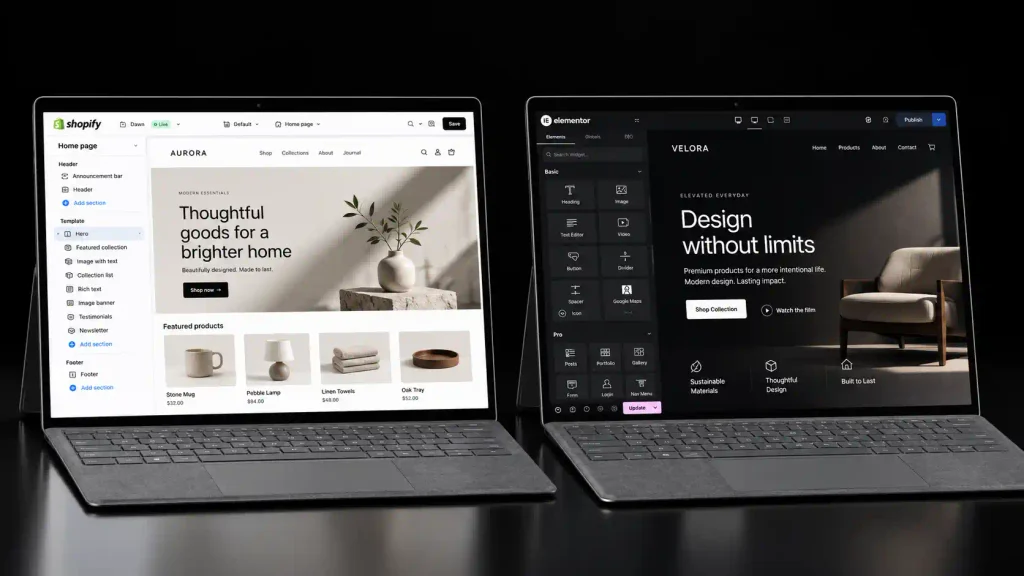
| Design control | Very high | High, within Shopify’s system |
| Custom development | Very flexible | Flexible, with platform limits |
| Maintenance | Your responsibility | Mostly handled by Shopify |
| SEO control | Extensive | Strong for most stores |
| Content management | Excellent | Good |
| Ease of use | Depends on the build | Generally easier |
| Platform fee | WooCommerce core is free | Monthly subscription |
| Server access | Full | No direct server access |
| Best fit | Custom and content-heavy websites | Ecommerce-first businesses |
The biggest difference is control
Shopify is a managed platform.
Hosting, platform updates, much of the security infrastructure and the core ecommerce system are handled for you. You work inside Shopify’s platform rather than managing the underlying server and software yourself.
WordPress works differently.
With WooCommerce, you control the hosting, website code, plugins, database and most aspects of how the website behaves. The core WooCommerce platform is open source and free to use.
That gives a capable development team much more freedom, but someone has to be responsible for maintaining it.
This difference affects almost everything else.
When Shopify is the better choice
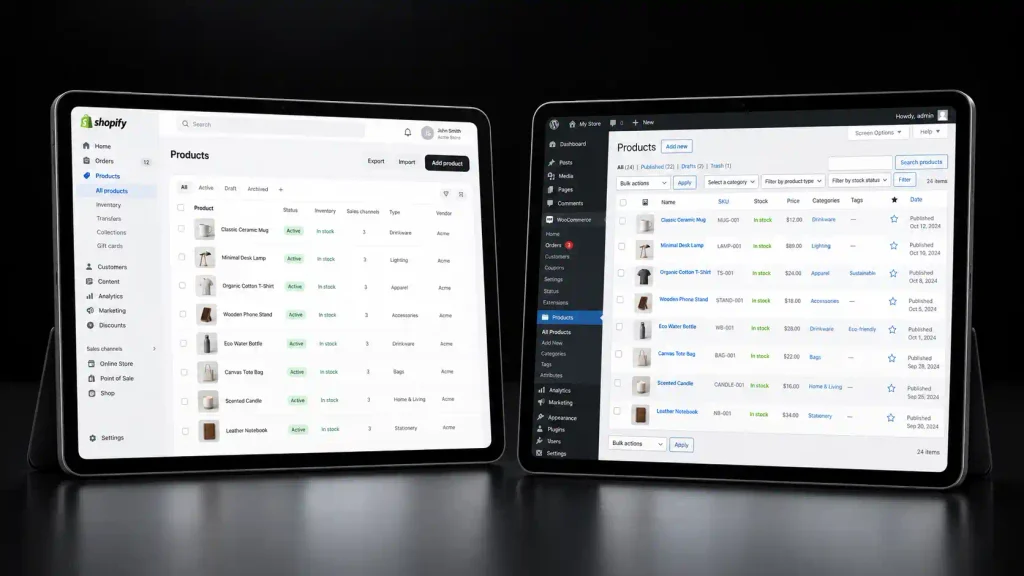
Shopify makes the most sense when you want to concentrate on selling products rather than managing website infrastructure.
It is particularly strong for stores that:
- want to launch quickly
- have a straightforward product catalog
- prefer a managed platform
- do not need unusual backend functionality
- want ecommerce tools available out of the box
- rely heavily on paid advertising and product sales
- do not have a developer maintaining the website
Shopify handles a lot of the boring technical work well.
Hosting is included. Updates are managed by Shopify. The checkout system is mature. Products, orders, inventory, discounts and payments are all part of the same platform.
For a business that simply needs a reliable online store, that simplicity has real value.
When WordPress and WooCommerce are the better choice
WordPress makes more sense when ecommerce is only one part of a larger website or when the project requires more control.
It is particularly strong for businesses that need:
- completely custom website layouts
- extensive service or landing pages
- large content libraries
- custom post types and taxonomies
- unusual product structures
- complex integrations
- custom user workflows
- membership or gated content
- granular technical SEO control
- functionality that does not fit neatly inside an ecommerce platform
A WordPress site can be a store, marketing website, content platform and custom web application at the same time.
That flexibility is one of its biggest advantages.
It is also why WordPress can become a mess when it is poorly built. More control means more opportunities to make bad technical decisions.
Which costs more?
There is no useful answer without looking at the actual project.
Shopify has a clear recurring platform cost. Its Basic plan currently starts at $29 per month when billed annually, with higher plans adding features and lower payment rates. Apps can add significant recurring costs depending on what the store needs.
WooCommerce itself does not charge a monthly platform fee. You pay separately for hosting, development and any premium extensions or services you use.
That does not mean WooCommerce is automatically cheaper.
A properly built WooCommerce store may require better hosting, ongoing maintenance and more development work than a comparable Shopify store.
On the other hand, a heavily customized Shopify store can accumulate substantial app and development costs.
The useful comparison is not the monthly platform price. It is the total cost of running the website you actually need.
Design and customization
WordPress has the higher ceiling.
A custom WordPress website can be built around almost any design system or content structure without needing to follow a predefined ecommerce architecture.
Shopify is also highly customizable. Custom themes and Liquid development allow experienced developers to build very distinctive stores.
The difference becomes more noticeable when the website needs functionality outside normal ecommerce patterns.
With WordPress, developers have access to the entire application and hosting environment.
With Shopify, development takes place within Shopify’s platform and APIs.
For most normal stores, that limitation is not a problem.
For unusual projects, it can be.
Which is better for SEO?
Both can rank extremely well.
Choosing WordPress because someone told you that Shopify is bad for SEO is not a good reason to choose a platform.
Shopify provides the technical basics needed for a well-optimized ecommerce website and handles many things automatically.
WordPress gives developers more control over the details.
That can include URL architecture, structured data, custom content types, metadata, redirects, internal linking systems, indexation rules and more advanced technical SEO work.
The advantage matters most when SEO is heavily dependent on content and custom site architecture.
For a straightforward ecommerce store, Shopify provides more than enough SEO capability.
For a website where organic search relies on hundreds of service pages, guides, resources, landing pages or custom content relationships, WordPress gives you more room to build exactly what the SEO strategy requires.
The platform does not create rankings by itself.
A fast Shopify store with good content and strong site structure will outperform a badly built WordPress site.
The reverse is equally true.
Content and blogging
This is one area where WordPress still has a clear advantage.
WordPress was built around content management and has a very mature system for posts, pages, categories, taxonomies, authors and custom content types.
That makes it particularly useful for businesses where educational content, landing pages, case studies and organic search are major parts of the acquisition strategy.
Shopify includes blogging and page management, and it is perfectly adequate for many businesses.
It simply does not provide the same level of content modeling and publishing flexibility as WordPress.
If your website is primarily a store with a blog attached, Shopify is usually fine.
If your website is a large content and marketing platform that also contains a store, WordPress becomes much more attractive.
Performance
Either platform can be fast.
Shopify has an advantage in consistency because hosting and much of the infrastructure are controlled by Shopify.
You cannot accidentally put the site on terrible shared hosting or configure the server badly.
WordPress gives you more control over performance, but the result depends heavily on the quality of the build.
A lightweight WordPress site on good infrastructure can be extremely fast.
A WordPress site running an oversized theme, poor hosting and dozens of unnecessary plugins can be painfully slow.
The same principle applies to Shopify apps and third-party scripts. Adding too many can hurt performance regardless of how good the underlying platform is.
Performance is primarily an implementation problem, not a WordPress versus Shopify problem.
Maintenance and security
Shopify wins on simplicity.
The platform, hosting and core infrastructure are managed for you. This removes a significant amount of routine technical maintenance.
WordPress requires active maintenance.
Core, themes and plugins need to be kept updated. Backups need to work. Hosting needs to be maintained. Security needs to be monitored. Plugin conflicts and PHP compatibility occasionally need attention.
For a business without technical support, this is a legitimate reason to choose Shopify.
For a business with managed WordPress hosting and an experienced development team, it is much less of a concern.
Ownership and portability
WordPress gives you more direct control over the entire website.
You choose the hosting provider and have access to the website files and database. WooCommerce is open source, so the store is not tied to one hosting company.
Shopify is a hosted SaaS platform.
You retain your business data and content, but the store operates inside Shopify’s infrastructure and platform rules.
For most businesses this is a reasonable tradeoff for the convenience Shopify provides.
For companies that require complete infrastructure control or highly specialized systems, WordPress may be the better fit.
Can both platforms scale?
Yes.
There are large businesses running on both Shopify and WooCommerce.
The question is not whether either platform can handle growth. It is what kind of growth you expect.
Shopify makes infrastructure scaling easier because the platform handles it.
WooCommerce gives you more control over how the infrastructure scales, but that requires the right hosting architecture and technical management.
A large catalog alone is not enough reason to choose one over the other.
You need to consider traffic, integrations, order volume, product complexity, content requirements and internal workflows together.
Should you switch platforms for SEO?
Usually not.
If your current Shopify or WooCommerce store is established and performing well, migrating purely because someone claims the other platform is “better for SEO” can create more problems than it solves.
Platform migrations change URLs, templates, internal links, structured data and other signals that search engines already understand.
A migration can be done safely, but it needs proper planning.
Existing URLs should be mapped to their replacements, redirects should be prepared before launch, metadata and structured data should be checked, and Search Console should be monitored after the move.
Switch platforms because the current platform is limiting the business, not because of a generic SEO claim.
So, which one should you choose?
For a straightforward ecommerce business that wants a reliable store with less technical responsibility, we usually recommend Shopify.
For a business that needs a highly customized website, serious content capabilities, unusual functionality or greater technical control, WordPress with WooCommerce is often the better fit.
There are plenty of exceptions.
That is why the right question is not “Which platform is better?”
It is “Which platform fits what this website actually needs to do?”
Brave Cat Digital builds both WordPress and Shopify websites. If you are choosing between them, we will recommend the platform that makes the most sense for the project, even when that means recommending the simpler option.