
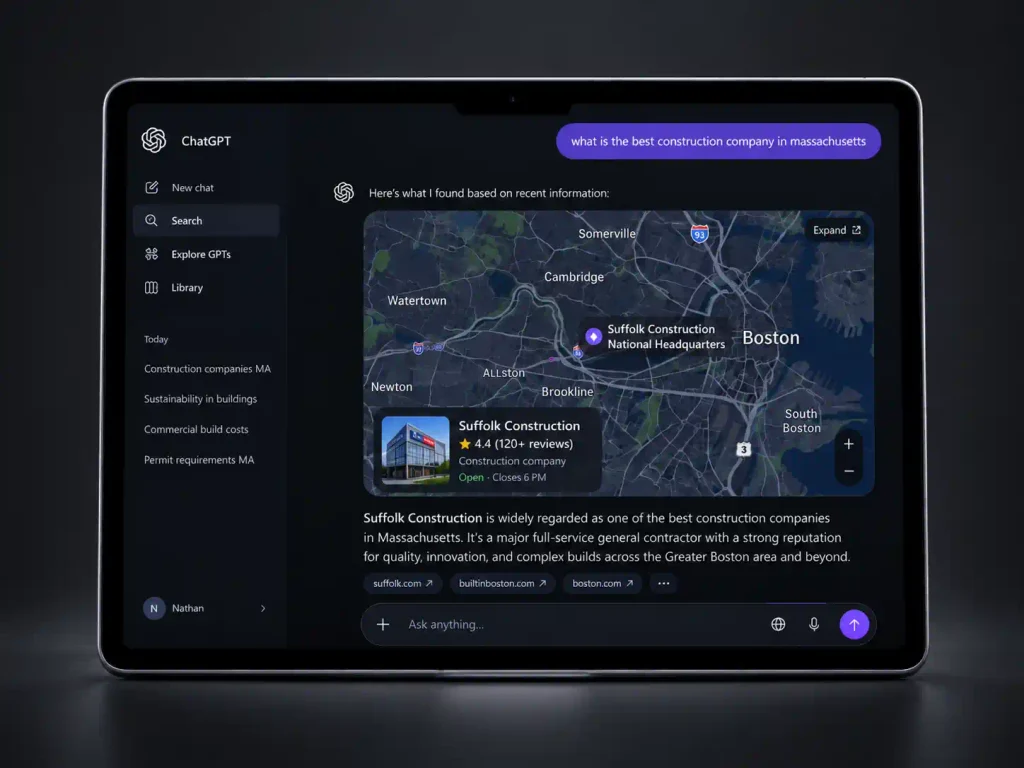
People are increasingly using ChatGPT to research products, compare services, find businesses and answer questions that would previously have started with a Google search.
That creates a new source of visibility for websites, but the fundamentals are less mysterious than much of the “AI SEO” advice online makes them sound.
There is no special button that makes ChatGPT recommend your business.
Your website needs to be accessible to the systems that power search, technically clear, useful enough to be worth citing and specific enough to answer the questions people are actually asking.
Here is what currently matters.
Can a website appear in ChatGPT Search?
Yes.
OpenAI states that any public website can appear in ChatGPT Search.
For your content to be discovered and included in summaries and snippets, OpenAI recommends allowing its search crawler, OAI-SearchBot, to access the relevant pages of your website.
That is the first thing to check before worrying about content formats, schema or AI optimization strategies.
If ChatGPT cannot properly access the page, everything else becomes less important.
1. Make sure OAI-SearchBot can crawl your website
OpenAI uses a crawler called OAI-SearchBot for search.
Check your robots.txt file and make sure you are not blocking it from the pages you want to appear in ChatGPT Search.
A simple configuration can look like this:
User-agent: OAI-SearchBot
Allow: /
That does not mean every page will automatically appear in ChatGPT.
It simply allows OpenAI’s search crawler to access the website.
Also check the other layers between the crawler and your content.
Security tools, firewalls, CDN rules and bot protection systems can sometimes block legitimate crawlers even when robots.txt allows them.
A website returning a 403 response to OAI-SearchBot is not meaningfully accessible just because the robots.txt file looks correct.
OAI-SearchBot and GPTBot are not the same thing
This distinction is important.
OAI-SearchBot is used for search discovery.
GPTBot is associated with content that may be used to improve OpenAI’s models.
You can make different decisions for each crawler.
A business may choose to allow OAI-SearchBot so its website can appear in ChatGPT Search while blocking GPTBot from accessing content for potential model training.
Do not assume that opting out of model training means you also need to disappear from ChatGPT Search.
They are separate controls.
2. Make sure the important pages are actually indexable
Crawler access is only part of the technical setup.
Pages you want people to discover should also be:
- publicly accessible
- served with a successful HTTP response
- free from accidental
noindexdirectives - connected through crawlable internal links
- assigned the correct canonical URL
- included in a clean XML sitemap where appropriate
- usable without requiring a login or interaction before the main content appears
The same technical problems that hurt normal search visibility can also make a website harder for AI search systems to discover and understand.
Before looking for an AI-specific solution, fix the normal technical SEO problems first.
3. Publish information worth citing
This is probably the most important part.
AI search systems do not need another version of an article that already exists on thousands of websites.
If your page simply rewrites common information with different wording, there is little reason for it to become a useful source.
Give the page something specific.
That can include:
- first-hand experience
- original research
- actual project results
- screenshots
- comparisons based on real use
- technical details
- original photography
- pricing information
- processes you actually use
- expert opinions you can explain
- examples from real projects
- data that can be verified
A web agency writing “10 Reasons Your Business Needs a Website” is adding very little to the internet.
A web agency publishing a detailed breakdown of how it reduced loading time on a real WooCommerce store, including what caused the problem and what was changed, has something worth referencing.
The difference is not the number of keywords.
It is the amount of useful information on the page.
4. Answer the actual question clearly
A page can be detailed without making the answer difficult to find.
If someone searches:
“What is better for a small ecommerce business, Shopify or WooCommerce?”
A useful comparison should answer that question directly before spending 2,000 words explaining every feature of both platforms.
Use clear headings.
Define things when they need defining.
Put important answers close to the sections they belong to.
Use tables and lists when they genuinely make information easier to compare.
Do not deliberately make content longer because you think AI systems prefer long articles.
There is no useful word count that applies to every topic.
Write enough to answer the question properly.
5. Use normal language instead of writing for a robot
You do not need to write strange sentences designed around how you imagine an AI model reads websites.
Modern search systems understand concepts, relationships and variations in language far better than older keyword matching systems did.
Use the terminology your customers actually use, but do not force every possible variation into the page.
For example, an article about WordPress performance might naturally contain:
- WordPress speed
- page load time
- Core Web Vitals
- caching
- image optimization
- hosting
- JavaScript
- database performance
Those terms belong there because they are part of the subject.
Repeating “WordPress speed optimization services” fifteen times does not make the article more useful to Google, ChatGPT or a human reader.
6. Make your business and expertise easy to understand
AI visibility is not only about individual blog posts.
The website as a whole should make it clear who is responsible for the information.
Useful trust signals include:
- a real About page
- clear company information
- author information where appropriate
- service pages explaining what the company actually does
- real project and case study pages
- consistent business information
- external profiles and references
- clear contact information
If a website claims expertise in ecommerce development but contains no ecommerce projects, no relevant services, no identifiable people and no original technical content, the claim is not very convincing.
Show the expertise instead of repeatedly stating that you have it.
7. Use structured data where it actually applies
Structured data is useful, but it is not a secret AI ranking system.
Use normal, accurate schema for the content that exists on the page.
Depending on the website, that may include:
- Organization
- Person
- Article
- BlogPosting
- BreadcrumbList
- Product
- LocalBusiness
- Service
- Review
The structured data should match information users can actually see on the website.
Do not add fake reviews, made-up ratings or irrelevant schema because an SEO plugin offers a field for it.
There is currently no special “ChatGPT schema” that guarantees inclusion in ChatGPT answers.
Good structured data is part of building a technically clear website. It is not a replacement for useful content.
8. Build strong internal relationships between pages
Internal linking helps search systems understand how pages on your website relate to each other.
A useful blog article should not exist as an isolated URL.
For example, a detailed article about WooCommerce performance could naturally connect to:
- a WooCommerce development service
- a website performance service
- a relevant ecommerce project
- another article about hosting
- a technical SEO guide
The anchor text should explain what the linked page contains.
Avoid vague internal links such as “click here” when a descriptive link makes more sense.
Internal linking also gives people an obvious path to continue researching the subject instead of reaching the end of an article and leaving.
9. Keep important information current
Freshness matters when the subject itself changes.
An article explaining HTML fundamentals does not need a new year added to the title every January.
An article covering Shopify pricing, ChatGPT Search, WordPress versions or Google Search features may need regular review because those facts change.
Update content when there is something meaningful to update.
Do not change a publication date every year without changing the article.
When a page contains time-sensitive information, make it clear when it was last reviewed.
That gives both readers and search systems more context about whether the information is still current.
10. Do not add an FAQ section just for AI
FAQs can be useful when readers genuinely have additional questions that the main article does not answer.
They are not a requirement for ChatGPT visibility.
Do not add five obvious questions to every article because someone said AI systems prefer FAQ formatting.
If a question deserves a full section, answer it properly in the article.
If several short questions remain after the main content, an FAQ may be a good format.
The structure should follow the information, not an SEO template.
11. Do not expect llms.txt to solve AI visibility
You may see recommendations to create an llms.txt file specifically for AI systems.
Do not treat it as a substitute for technical SEO, crawlability or useful content.
Google has explicitly stated that it does not use llms.txt for Search or its generative AI search features.
OpenAI’s current publisher guidance for appearing in ChatGPT Search focuses on allowing OAI-SearchBot and making public content accessible.
There is nothing wrong with maintaining an llms.txt file if another service you use supports it.
Just do not expect the file itself to make a weak or inaccessible website suddenly visible in AI search.
12. Make images useful too
Relevant original images can strengthen a page.
Use images that actually help explain the subject:
- screenshots
- diagrams
- before and after comparisons
- original project photography
- product examples
- interface comparisons
Give each useful image a descriptive filename and accurate alt text.
Do not fill alt attributes with keywords.
An image showing Shopify and WooCommerce product dashboards should have an alt description of what is visible, not something like “best ecommerce web design SEO company Shopify WooCommerce.”
Image optimization still needs the normal fundamentals:
- appropriate dimensions
- modern image formats
- compression
- width and height attributes
- lazy loading where appropriate
- responsive image delivery
13. Make the website easy for people and machines to use
Good technical implementation still matters.
Keep the HTML structure clear.
Use one logical page heading hierarchy.
Use real links for navigation.
Label buttons and interactive controls properly.
Make forms accessible.
Do not hide important information behind animations or unusual interfaces that make basic content difficult to access.
OpenAI has also highlighted accessibility information such as ARIA roles and labels as useful for AI agents interacting with websites.
Accessibility, usability and machine readability are increasingly connected.
That is another reason to build the interface properly instead of trying to patch it later with an “AI optimization” plugin.
14. Build real authority outside your own website
Your own website tells search systems what you say about yourself.
Other credible websites provide additional context.
Useful external signals can come from:
- industry publications
- legitimate business directories
- client websites
- interviews
- reviews
- awards
- professional profiles
- relevant media coverage
- original work people naturally reference
The goal is not to manufacture hundreds of mentions.
A handful of real references connected to actual work are more meaningful than a large number of low-quality directory profiles created only for SEO.
Keep company names, locations and other important entity information consistent when you control the listing.
15. Measure whether ChatGPT is actually sending traffic
Do not optimize blindly.
OpenAI adds utm_source=chatgpt.com to referral links from ChatGPT Search.
That means traffic can be measured in analytics tools such as Google Analytics.
Track:
- sessions from ChatGPT
- landing pages receiving those visits
- conversions from those sessions
- engagement after arrival
- which types of content are attracting AI referrals
Do not judge success only by manually asking ChatGPT whether it knows your company.
AI answers can vary based on the question, available sources, timing and other context.
Actual referral traffic and conversions are much more useful business metrics.
Is AI search optimization different from SEO?
Less than the industry sometimes makes it sound.
Terms such as AEO, GEO and AI SEO can be useful when discussing a specific part of search, but they do not replace the fundamentals of SEO.
The same website still needs:
- accessible pages
- good technical structure
- useful content
- clear entities
- internal links
- external authority
- accurate information
- good page experience
What is changing is the way that information can be surfaced.
A person may discover your business through a traditional Google result, an AI Overview, ChatGPT Search or another AI-powered interface.
The underlying goal remains the same.
Publish the best available answer or resource for the subject and make it technically easy to discover.
A practical ChatGPT Search checklist
If you want your website to have the best reasonable chance of appearing in ChatGPT Search, check the following:
- OAI-SearchBot is not blocked in robots.txt
- your firewall or CDN is not blocking the crawler
- important pages are public and indexable
- canonical URLs are configured correctly
- XML sitemaps contain the URLs you actually want indexed
- important pages are connected with internal links
- content answers real questions clearly
- articles include first-hand knowledge where possible
- claims are specific and supportable
- company and author information is clear
- appropriate structured data is implemented accurately
- images have descriptive alt text
- important content works without unnecessary interaction
- the website works properly on mobile
- analytics tracks referral traffic from ChatGPT
- important content is reviewed when the underlying information changes
None of these steps guarantees that ChatGPT will cite a particular page.
There is no published formula that does.
What they do is remove obvious technical barriers and give search systems better content to work with.
The bottom line
You do not need a separate website for AI search.
You need a good website that AI search systems can access and that contains information worth using.
Start with crawlability.
Build clear pages around topics you genuinely understand.
Publish original information instead of repeating what every competitor already says.
Make the business behind the content easy to verify.
Then measure whether those pages are actually bringing qualified visitors to the site.
That is a much stronger long-term strategy than chasing the latest “GEO hack.”