
A contractor website has a simple job: show what you do, prove that you can do it, and make it easy for the right customer to contact you.
The problem is that many contractor websites either say too little or try to put everything on one page.
A better structure gives each important service, project and location enough room to answer the questions customers actually have before requesting a quote.
For most contractor businesses, these seven page types are a strong place to start.
The 7-page contractor website structure
A solid contractor website usually needs:
- Home
- Services
- Individual Service Pages
- Projects
- About
- Reviews
- Contact / Request a Quote
That does not mean the entire website should contain exactly seven URLs.
If you offer five important services, each may deserve its own page. If you serve multiple locations, some may justify dedicated location pages. Projects may also have individual case study pages.
Think of these as seven core parts of the website rather than a hard page limit.
1. Home
The homepage should answer four questions quickly:
- What do you do?
- Where do you work?
- Why should someone trust you?
- What should they do next?
Do not start with a vague headline about quality or craftsmanship.
A visitor looking for a concrete contractor in Dallas should not have to scroll to understand that you provide concrete work in Dallas.
The first screen should usually contain:
- a clear description of the primary service
- the main service area
- a strong project or team image
- a primary call to action
- a phone number when phone leads matter
Further down the page, show the main services, recent work, reviews, credentials and service area.
The homepage should introduce the business. It should not try to explain every service in detail.
2. Services
The main Services page gives customers a clear overview of what you actually do.
Each primary service should have a short description and a link to a dedicated service page.
For example, a general contractor might offer:
- commercial construction
- tenant improvements
- concrete
- site work
- renovations
- design-build services
Do not create ten nearly identical service pages just because you want more keywords.
Create separate pages when the service is important enough that someone would realistically search for it, hire you specifically for it, and benefit from more detailed information.
3. Individual service pages
This is where many contractor websites leave a lot of SEO and conversion potential on the table.
Someone searching for a specific service usually wants more than a paragraph on a generic Services page.
A strong service page should explain:
- what the service includes
- who it is for
- where you provide it
- the types of projects you handle
- how the process works
- relevant experience or credentials
- examples of completed work
- common questions
- how to request an estimate
The page should be useful even if the visitor lands on it directly from Google and never sees the homepage.
Show proof on the service page
Do not separate all of your proof from the pages where customers make decisions.
If you have completed projects related to the service, show them.
If you have a relevant testimonial, use it.
If licenses, certifications or equipment matter for that type of work, mention them where they are relevant.
A visitor should not have to search the entire website to determine whether you can actually do the job.
4. Projects
For contractors, completed work is one of the strongest forms of proof.
A Projects page should show real projects rather than a gallery of unlabeled images.
At minimum, useful project information can include:
- project type
- service performed
- location
- scope of work
- project photos
For stronger projects, create an individual project page.
You do not need to write a long case study for every job. A concise project description with good photography and real details can provide significantly more value than a generic portfolio grid.
Use real photography
Real work almost always tells the story better than stock photography on a contractor website.
Show the crew, equipment, site conditions, completed work and details that make the project credible.
Professional photography is useful, but authenticity matters more than making every photo look like an advertisement.
5. About
The About page should answer a basic question:
Who am I hiring?
For a contractor, that can include:
- how long the company has been operating
- ownership or leadership
- relevant experience
- licenses and certifications
- insurance
- safety practices
- team members
- areas served
Avoid filling the page with generic statements about passion, integrity and excellence.
Show the things that make the company credible.
If the business is family-owned, say it.
If the same team has worked together for fifteen years, say it.
If you specialize in a particular type of commercial work, say that too.
Specific information creates more trust than generic company values.
6. Reviews
Reviews provide third-party proof that your own marketing copy cannot.
You can feature strong reviews throughout the website, but having a dedicated place for customer feedback can still be useful when you have enough of it.
Prioritize genuine reviews from platforms your customers already recognize.
Do not manufacture testimonials or rewrite them until they no longer sound like the customer.
If possible, connect reviews to the type of work being discussed.
A commercial remodeling testimonial is more useful on a commercial remodeling page than a completely unrelated residential review.
7. Contact / Request a Quote
The Contact page should make starting a conversation easy.
For most contractor businesses, useful fields include:
- name
- phone
- project location
- service needed
- project details
If project photos, plans or documents would help qualify the lead, allow file uploads.
Do not turn the initial inquiry into a twenty-question application unless there is a strong business reason for it.
You can collect additional information after the first contact.
Also provide alternatives to the form where appropriate:
- phone
- business hours
- office location
- service area
Where location pages fit
Location pages can be useful for contractors serving multiple cities or regions, but they need a reason to exist.
Changing the city name across twenty copies of the same page is not a local SEO strategy.
A useful location page can contain:
- services available in that area
- relevant projects nearby
- area-specific information
- customer reviews from that market
- photos from local work
- a clear service area description
Google says local results are primarily influenced by relevance, distance and prominence. Your website can help Google understand relevance, but creating hundreds of thin city pages does not change where your business is actually located.
Focus first on the places where you genuinely work and have something useful to show.
Google Business Profile matters too
The website is only one part of contractor local SEO.
Keep the Google Business Profile accurate and complete, including:
- business category
- contact information
- operating hours
- service areas
- services
- photos
Reviews also matter. Google explicitly lists review count and positive ratings among the signals that can contribute to local prominence.
Your website and Business Profile should tell the same story about the business.
Calls to action
Do not make visitors hunt for the next step.
For most contractor websites, the primary action will be something like:
- Request a Quote
- Get an Estimate
- Schedule a Consultation
- Call Now
Use one primary CTA consistently rather than changing the wording every few sections.
Longer pages can repeat the CTA where it makes sense, but there is no magic number of buttons that makes a page convert.
The CTA should appear when a visitor has enough information to reasonably take the next step.
Mobile matters more than the desktop mockup
A contractor website may be designed on a large monitor, but a large percentage of customers will experience it on a phone.
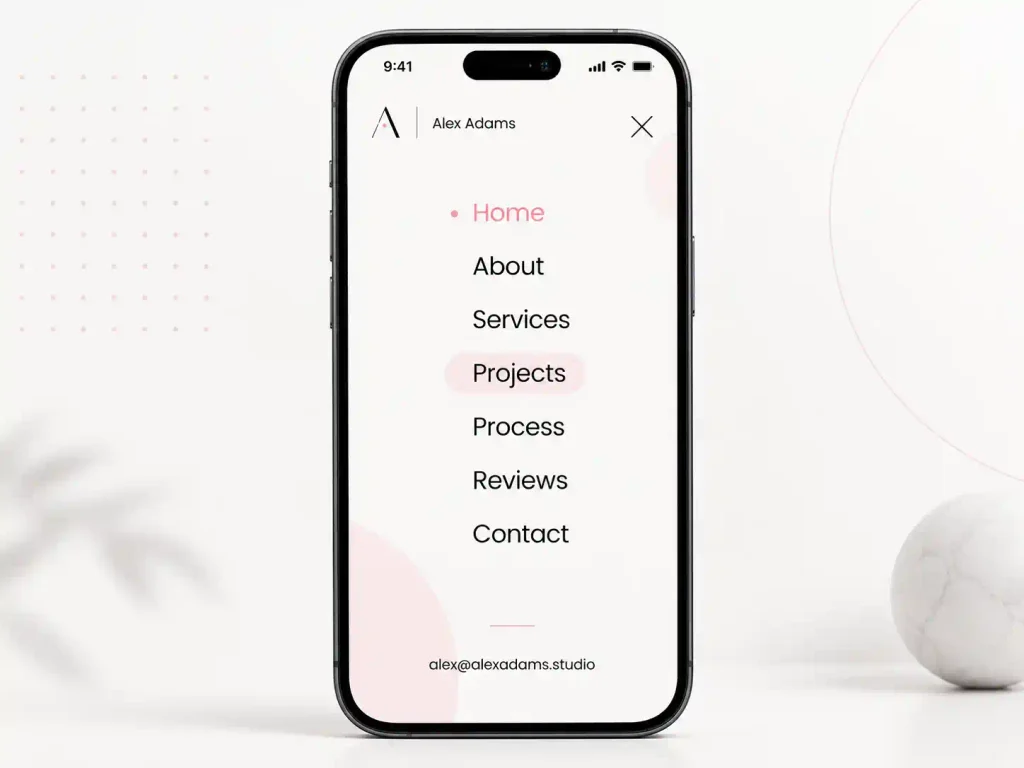
Important mobile details include:
- readable text
- clear navigation
- large tap targets
- easy-to-use forms
- click-to-call phone numbers
- properly sized images
- fast loading
- no intrusive popups covering the page
Test the actual website on real phones before launch.
Do not assume that shrinking the desktop layout means the mobile experience works.
Website speed
Contractor websites often become unnecessarily heavy because of:
- oversized project photos
- video backgrounds
- sliders
- animation libraries
- tracking scripts
- chat widgets
- poorly configured WordPress plugins
Images should be properly sized and compressed, and non-essential scripts should not block the first useful content from appearing.
Google recommends focusing on overall page experience rather than optimizing a site around one isolated metric. The goal is straightforward: the website should load quickly and remain responsive while someone is trying to use it.
What about SEO?
Good contractor SEO starts with useful pages that match the services people are actually looking for.
That normally means:
- one strong page for each important service
- clear service areas
- useful project pages
- descriptive page titles and headings
- crawlable internal links
- accurate business information
- relevant local proof
- a technically sound website
Do not create pages purely because a keyword tool gave you another variation of the same phrase.
Google’s own guidance recommends creating helpful, people-first content and using the words people actually search for in important locations such as titles, headings and link text.
A good website structure makes that easier because each page has a clear purpose.
A simple contractor website checklist
Before launching, check that the website has:
- a clear service and location in the homepage introduction
- dedicated pages for important services
- real project photography
- relevant reviews and credentials
- an About page with real company information
- an easy quote or contact process
- working click-to-call links on mobile
- clear internal links between related pages
- optimized images
- a fast mobile experience
- accurate business information
- properly configured analytics and Search Console
The website does not need to be complicated.
It needs to make the business easy to understand, easy to trust and easy to contact.
The right structure depends on the contractor
A seven-part structure is a good foundation, but the final sitemap should follow the business.
A roofing company with three services and one city does not need the same website as a commercial contractor operating across several states.
Start with the services customers actually hire you for, the locations you genuinely serve and the proof you already have.
Build the website around those things instead of trying to hit an arbitrary page count.
Brave Cat Digital designs and develops contractor websites around the way the business actually operates, with the structure, performance and SEO considered from the start.